
Animals
Tell Congress to protect breeding pigs as Farm Bill vote set for Thursday, April 30
Kirkpatrick Policy Group
By Brendan Hoover
A consequential moment in the years-long effort to free breeding pigs from extreme confinement in industrial animal agriculture will happen on Thursday, April 30, as the U.S. House of Representatives is set to vote on the 2026 Farm Bill (H.R. 7567).
The 850-page Farm Bill contains provisions that would eliminate critical animal protections across the country, forcing animals back into cages and further entrenching cruel factory farming. Specifically, Section 12006 would federally override laws such as California’s Proposition 12 and Question 3 in Massachusetts, which ban the sale of whole pork products produced using confinement housing systems such as gestation crates for pregnant pigs.
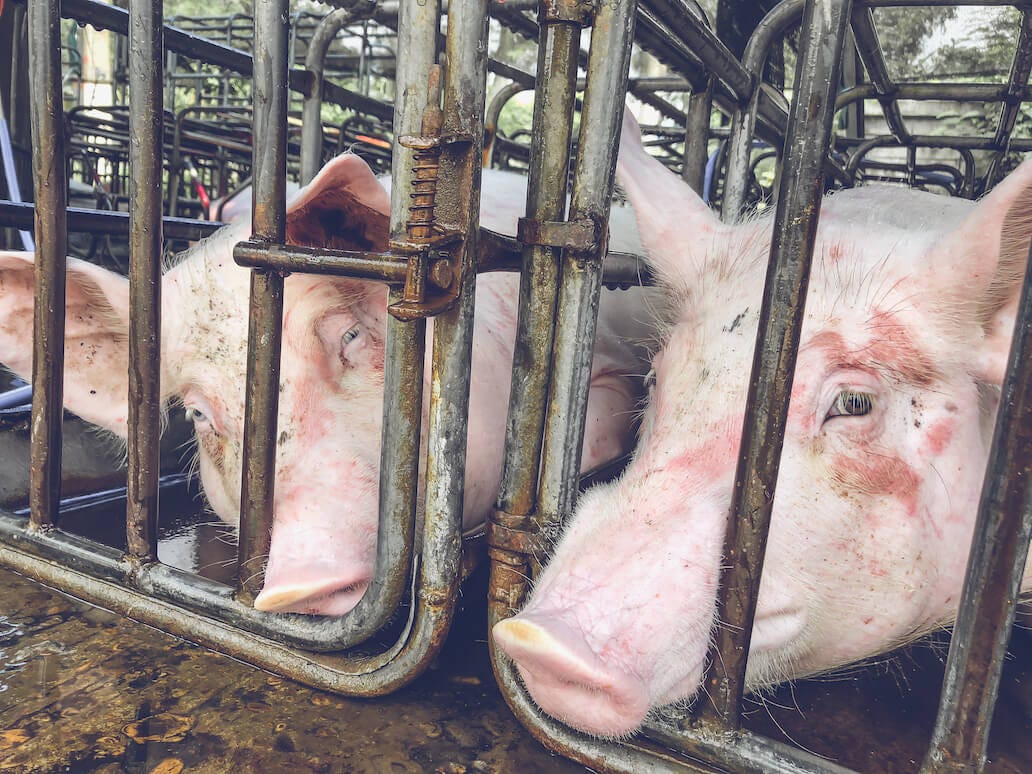
Gestation crates are widely considered cruel and inhumane, and they have been banned in eleven U.S. states, four nations, and the European Union (partial ban). A Kirkpatrick Foundation report on the extreme confinement of pregnant pigs in Oklahoma, The Way Forward, describes the horrors of life inside a gestation crate: “These metal crates—measuring 6.6 feet long by 2 feet wide—are so restrictive that the pigs can’t turn around, walk, curl up, or interact normally with other pigs. They will stand in these cruel crates for three to four years until depleted by repeated pregnancies. Having developed painful lameness, they will then struggle to walk for transport to slaughter.”
Kirkpatrick Policy Group urges all Oklahomans to tell their Congress members to vote YES on the Luna Amendment, which would remove Section 12006. If the section is not removed, urge Congress to vote NO on the Farm Bill.
Overturning Prop 12 and Question 3 has been a long‑standing goal of the National Pork Producers Council since those laws were approved by voters in 2018 and 2016, respectively.
Critics of Section 12006—which mirrors the 2025 pork-industry backed Save Our Bacon Act—say the provision would amount to one of the most sweeping federal preemptions of state agricultural laws in modern history. If enacted, Section 12006 would override hundreds of state and local regulations governing the sale of agricultural products.
There are nearly six million breeding pigs across the nation, according to the United States Department of Agriculture. The pork industry claims gestation crates reduce production costs. However, a 2024 International Pig Veterinary Society (IPVS) report found that gestation crate housing systems were only 2.78 percent more efficient than group housing systems. Furthermore, the difference in efficiency is cancelled out by increased productivity among gestating sows in group housing (chiefly in farrowing rate, pigs born alive, and slaughter weight), the IPVS report states.
Since Prop 12 went into effect in 2023, retail prices in California for whole pork products have risen but farmed animal advocates counter by arguing that the tradeoff—accepting ethically reprehensible production methods in return for cheaper meat products—has a much higher societal cost.
“The current system of industrial animal production is not sustainable and presents unacceptable risks to public health, the environment, and animal welfare,” stated the Pew Commission on Industrial Farm Animal Production, an independent commission funded by The Pew Charitable Trusts, in 2008.
About 70 percent of the U.S. pork industry is controlled by just four companies—WH Group (a Chinese corporation that owns Smithfield Foods), Brazilian-owned JBS, Tyson, and Hormel—according to Farm Action, a nonpartisan, farmer-led watchdog organization.
Oklahoma has about 420,000 breeding sows, nearly all living in gestation crates, and the state exports more than two billion pounds annually, according to the Oklahoma Pork Council. The Seaboard Foods plant in Guymon slaughters about 21,500 hogs daily.
Laws like Prop 12 and Question 3 have created a market for independent hog farmers who utilize group housing or pasture raised systems, and about sixty major food retailers representing over 90 percent of U.S. pork sales have made public declarations in opposition to gestation crates, according to the Center for a Humane Economy, a national nonprofit.
The Save Our Bacon Act (the inspiration for Section 12006) also violates the Tenth Amendment of the U.S. Constitution. “The language challenges the balance of power between federal and state governments, potentially going beyond valid preemption. It raises questions regarding federal overreach, the Tenth Amendment, and state autonomy,” states an analysis of the legislation by the Brooks McCormick Jr. Animal Law Policy Program of Harvard Law School.
Overturning state laws protecting breeding sows would negatively affect much more than just animal well-being. For these reasons, KPG supports the Luna Amendment to the Farm Bill, which would remove Section 12006. If the section is not removed, KPG calls on Oklahoma’s Congressional delegation to vote NO on the 2026 Farm Bill.
OK-1 Congressman Kevin Hern, 202-225-2211, or click here to email.
OK-2 Congressman Josh Brecheen, 202-225-2701, or click here to email.
OK-3 Congressman Frank Lucas, 202-225-5565, or click here to email.
OK-4 Congressman Tom Cole, 202-225-6165, or click here to email.
OK-5 Congresswoman Stephanie Bice, 202-225-2132, or click here to email.
Don’t know who your member of Congress is? Download the KPG Connect app here.
Kirkpatrick Policy Group is a non-partisan, independent, 501(c)(4) nonprofit organization established in 2017 to identify, support, and advocate for positions on issues affecting all Oklahomans, including concern for the arts and arts education, animals, women’s reproductive health, and protecting the state’s initiative and referendum process. Improving the quality of life for Oklahomans is KPG’s primary vision, seeking to accomplish this through its values of collaboration, respect, education, and stewardship.